- Towards AGI
- Posts
- AI Isn’t a Tool Anymore, It’s Becoming Your Daily Decision Partner
AI Isn’t a Tool Anymore, It’s Becoming Your Daily Decision Partner
The State of GenAI and Consumers 2026.

Shen Pandi
February 17, 2026
Here is what’s new in the AI world.
AI news: Why Consumers Now See AI as a Cognitive Partner
Hot Tea: GPU Orchestration Emerges as the Real Bottleneck
Open AI: Alibaba’s Qwen-3.5 Signals the Global Race to Scale Open AI Models
OpenAI: OpenClaw’s Creator Joins OpenAI
From Skepticism to Daily Habit: The Duality of GenAI Adoption in 2026
Generative AI is no longer a niche phenomenon. It’s rapidly revolutionizing the way people think, search, and decide.
The latest data from Forrester predicts a shift for Gen AI: by 2026, the technology will move from being a productivity tool to a trustworthy cognitive companion in people’s lives.
Widespread Adoption and Emergent Habits
Forrester’s research reveals that a whopping 62% of users around the globe are engaging with Gen AI at least once a week, with many turning to it daily as their go-to source for answers.
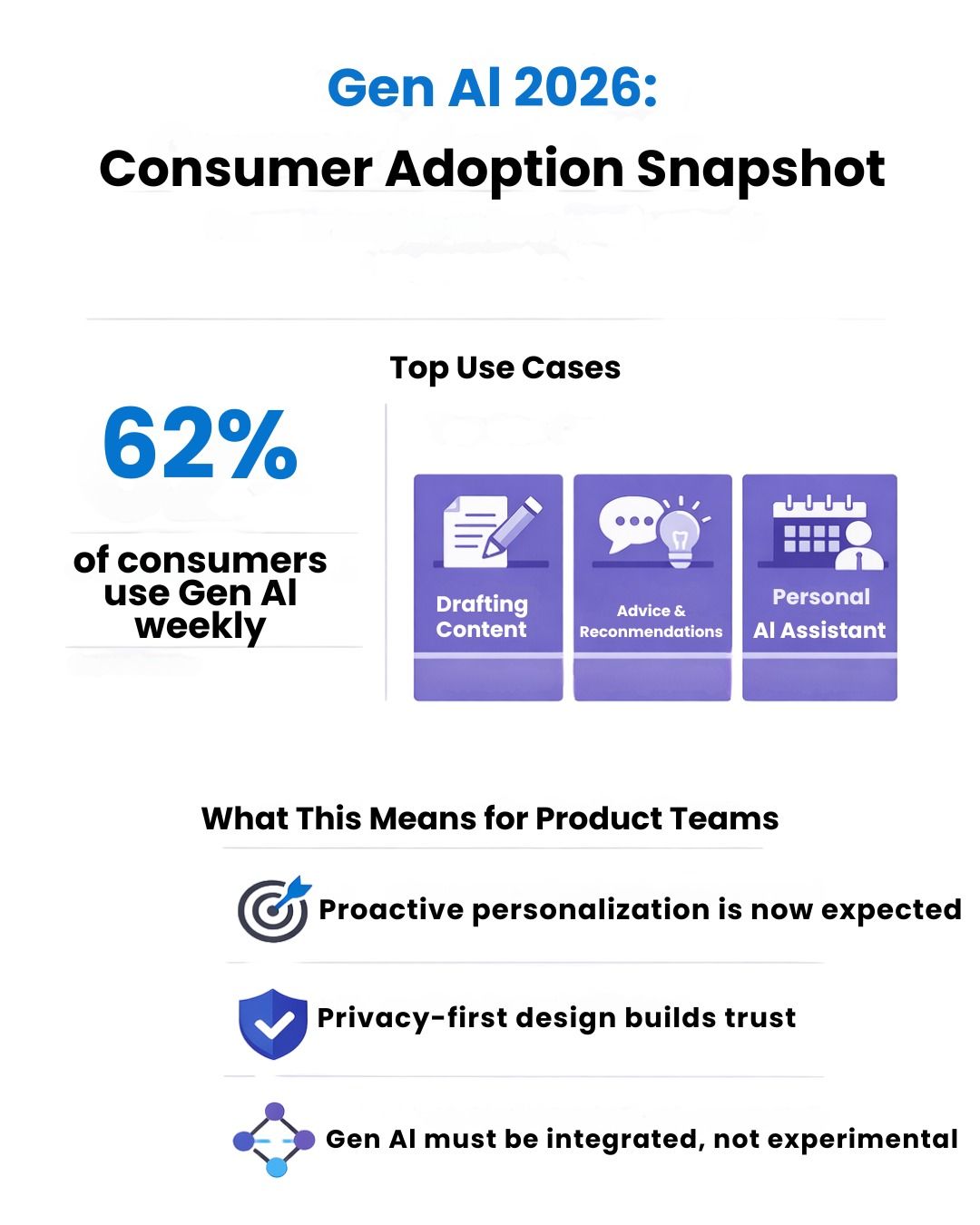
This trend highlights a significant change in how consumers behave, as they start to weave these tools into their everyday tasks-whether it’s for writing, planning, or getting personalized recommendations and solving problems.
Millions are tapping into Gen AI for drafting content
A similar number depends on it for advice and recommendations.
Increasingly, Gen AI is seen as accessible and non-judgmental, blurring the line between productivity software and a digital companion.
Blurring Lines Between Utility and Everyday Life
People are increasingly integrating Gen AI into their digital lives. The friendly, free, and integrated nature of Gen AI on existing platforms has helped the technology gain traction among people of all ages and backgrounds.
Despite the existing privacy and misinformation issues, Forrester asserts that the use of AI technology continues to grow. This phenomenon is transforming the way people seek information, shop, and engage with brands.
A New Consumer Dynamic
By 2026, generative AI will transition from being a fun novelty to an essential part of our lives. According to insights from Forrester, we can expect a future where consumers look for proactive and personalized AI support.
Organizations that don’t keep up with these changes may find themselves losing their relevance in the market.
Why This Shift Is Positive for the Market?
From an economic perspective, the trend is obviously good. Generative AI makes it easier for people to find information, weigh decisions, and act with confidence.
As trusted AI becomes an extension of human judgment, people gain clarity faster, and brands reach customers who are more informed and eager to act.
Generative AI does not diminish value; it enhances it. It rewards truth, transparency, and utility while making personalization more accessible at lower costs than before. In sectors like insurance, financial services, retail, and healthcare, it means better guidance at scale.
Artificial intelligence is not meant to replace human judgment. It is meant to amplify it. To reach the right people with good products, clear value propositions, and trusted brands is not a destructive shift in the market. It is a healthy one.
By enabling businesses to deploy specialized AI agents across sectors like insurance, financial services, and retail, AgentsX embodies this enhancement-first approach.

With support for over 110 AI use cases across these key industries, AgentsX provides the infrastructure to turn this healthy market evolution into practical reality.
Your agents can deliver transparent, truthful, and highly useful interactions with customers, making personalization accessible and cost-effective exactly as you described.
SoftBank and AMD Back GPU Orchestration to Power Next-Generation AI Infrastructure
The actual challenge in artificial intelligence today is not about making the models intelligent enough, but about keeping the underlying infrastructure in check.
As artificial intelligence models are scaled up in size and complexity, the focus shifts from simply putting in place intelligent enough GPUs to putting them in place in a coordinated fashion across extensive networks.
The teamwork required to do so highlights GPU orchestration as a key part of the infrastructure in the years to come.
This marks a significant shift in the direction of artificial intelligence computing in the years to come.
Why GPU Orchestration Is Crucial Now
Today’s AI workloads aren’t just stuck on one chip or server anymore. They depend on thousands of GPUs working together, often across hybrid and cloud environments. Without smart coordination, these resources can be underutilized, inefficient, and pricey.
GPU orchestration addresses this problem by dynamically allocating and managing GPU resources across workloads, users, and locations.
According to the Fast Mode report, SoftBank and AMD validated a GPU orchestration platform designed to improve utilization while supporting the extreme performance demands of AI training and inference.
The core insight is simple but powerful: raw compute is no longer enough - orchestration is what turns compute into usable AI capacity.
SoftBank’s Infrastructure Bet Goes Deeper
SoftBank is essentially saying that its mandate for AI investments extends beyond simply investing in AI-based appsand instead encompasses helping to form the infrastructure upon which these apps run.
Rather than just being a consumer of such apps, the company’s now positioning itself as a long-term backer of fundamental AI tech.
In supporting GPU orchestration, SoftBank is betting on:
The relentless boom in AI workloads
The need for more efficient, large-scale compute coordination
Infrastructure software is now as important as hardware.
This is pretty much in keeping with SoftBank’s bigger vision of a world powered by AI - where compute efficiency will be what differentiates those who are in the lead and those who lag behind.
AMD’s Role: Extending Value Beyond Silicon
The validation, to AMD at least, is about more than whether its new hardware works. Though GPUs are core to its AI strategy, the company acknowledges that performance gains increasingly rely on system-level tuning vs. chip improvements alone.
The Fast Mode report specifies AMD’s involvement, validating the orchestration platform for high-performance GPU needs. The move is a significant strategic recognition: the future of AI compute is in tightly-integrated hardware software stacks.
Instead of competing only on pure processing power, AMD is hooking itself into infrastructural solutions that will help drive the real-world performance of its GPUs at scale.
SoftBank and AMD have demonstrated an underlying truth about the world of AI: the winners in the world of AI will be those who can scale intelligence in an efficient and cost-effective manner.
While the GPU is currently the driving force behind many AI technologies, the actual brain of the operation is orchestration. This is the system that brings everything together.
By investing in this system, SoftBank and AMD are not investing in a fad; they are investing in the underlying structural core of what is to come in the world of AI.
As the world of AI continues to expand, orchestration is no longer an optional component of computing. It is what separates computing that exists from computing that actually has value.
Alibaba has introduced Qwen-3.5 in a bid to compete with world leaders
Alibaba Cloud has introduced Qwen-3.5, a large language model developed by the company. This is significant in the emerging global race for foundation AI systems.
This is because Qwen-3.5 is a multimodal model with open weights. This indicates that China is ready for the next stage in the use of AI systems in the world.
A Clear Vision for the “Agentic AI Era”
At its core, Qwen-3.5 is not just an improvement but represents a new age of agentic AIs. The term “agentic” refers to artificial intelligence agents that are capable of performing actions, as opposed to simply reacting to input.
This new generation of Qwen will be capable of directly processing text, images, or videos, and will be able to handle complex tasks with minimal supervision.
Alibaba has designed Qwen-3.5 for a world where AI systems function as digital agents. This means that Qwen-3.5 is designed for a world where AI systems do not require human intervention in performing multiple steps.
Cost, Performance, and Efficiency as Strategic Weapons
Alibaba’s latest reveal emphasizes the importance of efficiency as a key factor in its competitive advantage. Qwen-3.5 reportedly offers up to eight times the processing efficiency of its predecessor, along with reducing the cost of running it by up to 60%.
For businesses, the cost of inference is one of the key factors in taking their AI initiatives beyond the pilot stage.
The multimodal design of the model improves its ability to understand the context. The speed and power of the multimodal design make the Qwen-3.5 system more than a technology innovation - it makes the system a viable system for large-scale use.
Why Open Weights Matter in the Global AI Race
Another standout move that Alibaba is making with Qwen-3.5 is that the organization is releasing the model with open weights.
This means that the organization is allowing developers to customize, fine-tune, and utilize the model without any heavy restrictions, which is a refreshing change from many other Western-style AI systems that are heavily locked down and proprietary.

There are three main goals that Alibaba is trying to accomplish with this approach:
Accelerating the adoption of Qwen-3.5 among global developers.
Encouraging innovation throughout the ecosystem.
Reducing barriers for new companies and enterprises that wish to integrate AI.
By going the open route, Alibaba is positioning Qwen-3.5 as a versatile foundation model that can reach many markets where cost, flexibility, and adaptability are paramount.
Competitive Positioning Against Global Leaders
Alibaba is positioning Qwen-3.5, roughly on par with the top AI models from big U.S. players like OpenAI, Google DeepMind, and Anthropic.
Even if no actual figures are disclosed, the point is that Qwen-3.5 is aimed at the international market, not just local markets
This is a step in the opposite direction from the idea that AI models from China are intended for domestic use only and are restricted from being deployed elsewhere due to regulations.
Strategic Timing in an Escalating AI Arms Race
The timing of Qwen-3.5 is interesting in that it has been released at a time when the world’s AI race is only getting fiercer.
The Chinese are spending more on AI development, and the West is unveiling its latest upgrades. In that sense, it appears Alibaba is making a move here that will influence the course of the AI race in the years and decades ahead.
In this case, Qwen-3.5 is not just another product; rather, it is a declaration about how AI models need to expand and be beneficial in different sectors.
A Carefully Crafted Bid for Leadership in AI
The launch of Qwen-3.5 by Alibaba marks a major development in the international AI markets.
With multimodal intelligence, agentic execution, and operational efficiency integrated with open access, Alibaba is proving to be a heavy-hitter in the race to influence the future of AI infrastructure.
To what extent Qwen‑3.5 will actually change the game for enterprise adoption is debatable. What’s evident, though, is that Alibaba is no longer just keeping up with global AI trends - it’s actively working to lead the charge.
OpenClaw Developer Peter Steinberger Joins OpenAI And Keeps His AI Agent Open Source
In a move that bridges grassroots innovation and institutional AI leadership, OpenClaw developer Peter Steinberger has joined OpenAI - while making a clear commitment to keep his AI agent open source.
The decision highlights a growing tension in the AI ecosystem: how to scale innovation inside major organizations without sacrificing the transparency and community-driven values that fueled it in the first place.
Steinberger’s choice offers a revealing glimpse into how elite AI talent is shaping the future from the inside - without abandoning open development principles.

Steinberger’s commitment offers a fascinating glimpse into how top-tier leadership is charting a course for the future from inside the system.
From Independent Experiment to Industry Attention
OpenClaw was unique as an AI agent designed to wander freely in virtual spaces. It proved that agent-based systems could be used to accomplish real work, not just answer queries.
Developed by itself, OpenClaw represented a broader trend in artificial intelligence as a field of creating action-oriented tools, not just conversational ones.
According to Trending Topics, OpenClaw’s growing prominence and audacity inspired OpenAI. Steinberger’s project proved that small open-source projects could influence the large trends in artificial intelligence if they ventured beyond user interfaces.
Why OpenAI Made the Move
Steinberger joined OpenAI in its broader effort to create agentic AI, or artificial intelligence that can think through a problem, plan, and act on those plans with little or no human intervention.
Steinberger’s experience in actually making a working artificial intelligence agent from scratch can provide a down-to-earth view of the difficult, large-scale challenges we still face in making artificial intelligence autonomous, safe, and user-friendly.
Instead of putting OpenClaw in a closed system, OpenAI has kept Steinberger’s code in the open-source realm. This might represent a strategic bet that the tinkerers can help speed up the latest research.

Keeping OpenClaw Open Source Matters
Steinberger has been very vocal about his commitment: OpenClaw will remain open source despite his new role. This is important in a world that is increasingly proprietary and exclusive.
By keeping OpenClaw open source, we benefit:
Ongoing cooperation and openness within our community.
Opportunities for independent exploration beyond corporate plans.
Accelerated innovation driven by feedback from actual developers in the field.
To developers and AI entrepreneurs everywhere: you don’t have to sacrifice open innovation just because you’re joining a prominent AI lab.
A Signal to the Broader AI Community
This hire represents a larger trend: the best artificial intelligence labs are increasingly open to hiring builders who have proven their mettle in public spaces.
Instead of relying solely on academic qualifications, OpenAI and other firms are beginning to value hands-on experience, deployment, and community trust.
Meanwhile, Steinberger’s experience represents a new middle ground: open-source projects can be independent while their creators help shape large-scale artificial intelligence infrastructure and safety research.
A Model for Hybrid AI Innovation
Peter Steinberger's shift from an independent developer to an OpenAI member, with OpenClaw still thriving, represents a pathway to advancing AI. It shows the coexistence of openness and large-scale organizations.
When AI agents are about to emerge into the real world, this balance will be important. The future of AI will not be the result of closed labs or be developed in isolation. It will be the result of the intersection of openness and organization.
Journey Towards AGI
Research and advisory firm guiding on the journey to Artificial General Intelligence
Know Your Inference Maximising GenAI impact on performance and Efficiency. | FREE! AI Consultation Connect with us, and get end-to-end guidance on AI implementation. |
Your opinion matters!
Hope you loved reading our piece of newsletter as much as we had fun writing it.
Share your experience and feedback with us below ‘cause we take your critique very critically.
How's your experience? |
Thank you for reading
-Shen & Towards AGI team